This article was first published by "In The Cattle Markets" on Oct. 31, 2022.\
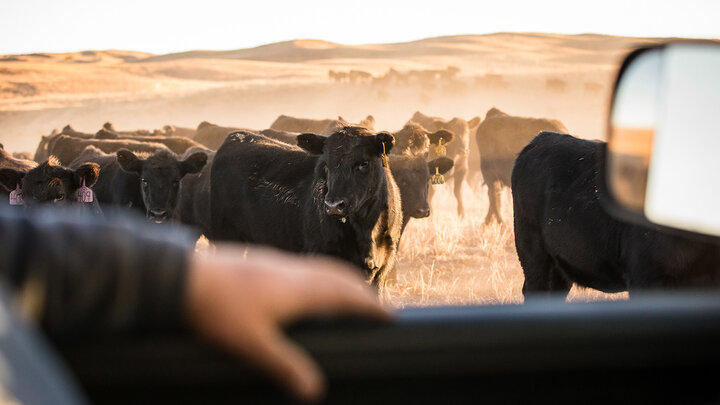
Cumulative national feeder and stocker cattle receipts are slightly lagging both 2021 and the five-year average (2017–2021) at 12,098,700 head through Oct. 21. In 2022, more of the receipts are coming from cattle weighing less than 600 pounds and from heifers — both signals that drought in various parts of the United States is affecting feeder and stocker cattle being sold.
Cow-calf producers who still have calves are in the process of deciding whether to sell or retain weaned calves. This decision must consider both the cost to put on additional weight — including the total amount, quality, and cost of feed resources — and the expected price received when cattle are sold at higher weights using current and future basis-adjusted prices. The difference between these two values is profit, but only on the additional weight gained. Positive values indicate that profits could be made by retaining feeder cattle this fall.
Survey work from the University of Nebraska–Lincoln shows that producers can use a combination of price risk management and different lengths in their production system as a hedge against adverse price movements. Putting on weight during the winter and selling in March–April, or selling in the late summer, are the two common backgrounding production systems in Nebraska. Within these two systems, total weight gain can be influenced by the type of feed used. Table 1 shows group-level trial data for these two types of systems in Nebraska.
Gain can be either fast or slow in both the winter stocking 2022–23 and summer grazing 2023 seasons. These decisions impact the total weight gained at each phase and, in turn, the time and weight at which feeder cattle enter feedlots.
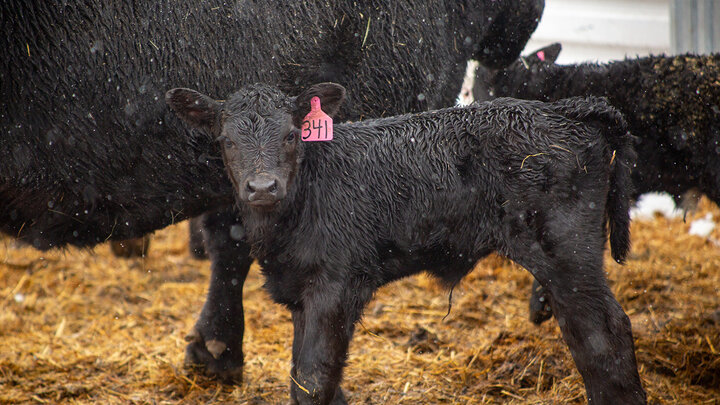
The value of gain for the two wintering scenarios — slow versus fast — is calculated using 66 head of 525-pound weaned steers purchased on Nov. 2, 2022, and sold in Lexington, Nebraska, on March 9, 2023, using Beef Basis. The value of gain for the slow winter performance, using an average daily gain (ADG) of 0.80 pounds per day, is $198.96 per hundredweight. The value of gain for the fast winter performance, using an ADG of 2.05 pounds per day, is $137.45 per hundredweight. Within each of these production systems, there is little advantage to speeding up or slowing down cattle, as the value of gain does not vary substantially in the two weeks before or after the proposed sale date (see Table 2).
These calculations are specific to cattle sold in Lexington, Nebraska, and producers making decisions about whether to retain cattle should recalculate the value of gain for their location using tools such as those available through Beef Basis. Similarly, these values are based on current prices and historical basis. Without price risk management, the actual price received will differ.
If price risk management tools are used, such as CME futures or options or USDA Risk Management Agency Livestock Risk Protection (LRP), producers can reduce some of this risk by “locking in” an output price, though they remain subject to basis risk.
Producers who retain cattle over the winter should recalculate the value of gain for cattle in the spring as they come off cornstalks or winter grazing. This helps determine whether the market is still willing to pay for additional weight gain.
Table 1. Rate of winter gain and length of grazing
| - | Slow–Short | Slow–Long | Fast–Short | Fast–Long |
|---|---|---|---|---|
| Panel (a): Winter Performance | ||||
| Gain (lb/day) | 0.79 | 0.79 | 2.04 | 2.04 |
| Body weight (lb) | 627 | 627 | 785 | 785 |
| Panel (b): Grass Performance | ||||
| Gain (lb/day) | 2.50 | 2.01 | 1.44 | 1.29 |
| Body weight (lb) | 779 | 866 | 867 | 938 |
Source: Klopfenstein et al. (2020)
Note: Calves are placed at 525 pounds. Winter grazing consists of 127 days on cornstalks. Short summer grazing is 62 days on summer grass, and long summer grazing is 120 days on summer grass. Slow winter grazing assumes cattle are fed 2 pounds of distillers grains daily, while fast winter grazing assumes cattle are fed 5 pounds of distillers grains daily.
Table 2. Value of Gain Under Different Winter Performance Scenarios in Lexington, Nebraska
| Sell date | Sell price ($/cwt.) | Days on feed (d) | ADG (lb/day) | Value of gain ($/cwt.) |
|---|---|---|---|---|
| Panel (a): Slow Winter Performance | ||||
| Feb. 25, 2023 | 208.67 | 115 | 0.89 | 198.04 |
| March 3, 2023 | 208.74 | 121 | 0.84 | 198.48 |
| March 9, 2023* | 208.82 | 127 | 0.80 | 198.96 |
| March 16, 2023 | 208.88 | 134 | 0.76 | 199.30 |
| March 23, 2023 | 208.67 | 141 | 0.72 | 198.05 |
| Panel (b): Fast Winter Performance | ||||
| Feb. 25, 2023 | 186.76 | 115 | 2.26 | 138.34 |
| March 3, 2023 | 186.61 | 121 | 2.15 | 137.90 |
| March 9, 2023* | 186.46 | 127 | 2.05 | 137.45 |
| March 16, 2023 | 186.31 | 134 | 1.94 | 136.97 |
| March 23, 2023 | 186.30 | 141 | 1.84 | 136.97 |
*Rows are the two base scenarios. Sell prices are based on current CME feeder cattle and corn contracts adjusted for historical basis for feeder cattle sold in Lexington, Nebraska.