Nebraska Fencing Law
Livestock owner responsibility
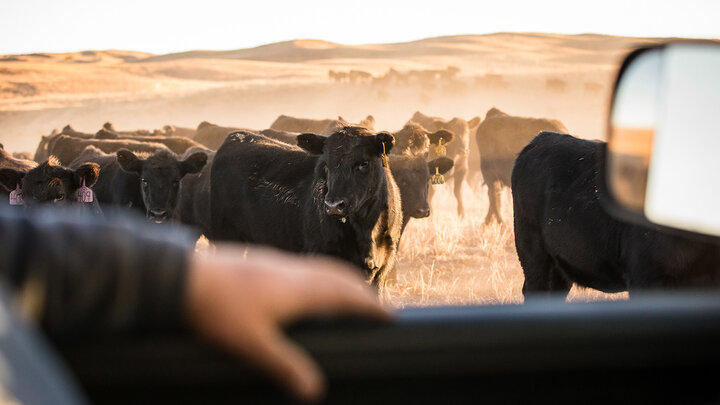
Nebraska livestock owners are required to use reasonable care to prevent their livestock from escaping the owner’s control. Nebraska livestock owners are liable for any damage their trespassing livestock cause when the owner does not use reasonable care to prevent livestock trespass. Nebraska law does not specifically require livestock owners to fence their livestock in, but that often is the most reasonable and practical way to prevent livestock trespass.
Shared Property Lines
A general rule of thumb used by Nebraska landowners to establish or maintain shared fence lines is to meet in the middle of the boundary and have each individual look to the right to identify their responsible portion. The part of the fence line to the individual’s right is the portion of the fence line the landowner would either establish or maintain.
According to current fence laws in Nebraska, landowners are required to equally split the cost of establishing and maintaining a fence to divide their properties unless otherwise agreed upon. Property line fences are not required if neither neighbor wants the fence. However, if one neighbor wants a fence, the fence builder can require the neighbor to pay half the cost of the fence (NRS §34- 102).
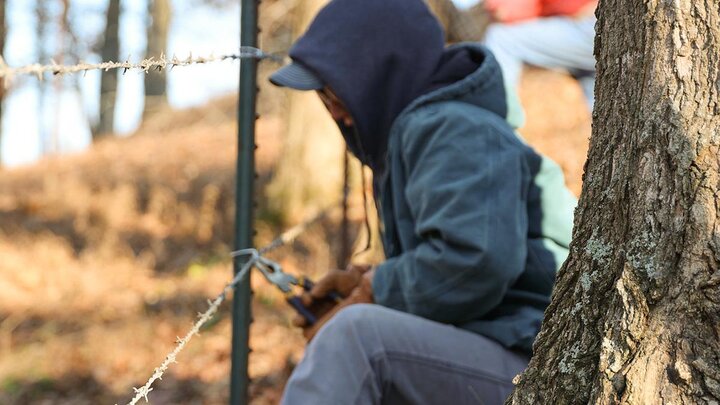
If the fence builder is going to pay for the fence, the statute does not restrict the type of fence built. But if the fence builder wants the neighbor to be responsible for half the fence, the fence must be at least four wires, at least number nine fencing wire and attached to posts no more than one rod (16.5 feet) apart, with a post or stake between every two posts. Barbed wire may be used, but is not required. The fence must be at least 4.5 feet high, with no more than one foot between the wires, measured from the top. If the neighbors both agree, a different type of fence may be constructed (NRS §§34-102(2),-115(5),-116).
If both neighbors do not agree on paying for the fence you intend to build, maintain or repair, you must formally serve written notice upon the neighbor that you are going to build, maintain or repair the fence. You should obtain legal assistance here. If the neighboring landowner does not live on the land, you must serve the notice to whoever lives there or the owner's agent (probably a tenant). The written notice must request that the neighbor either build, maintain or repair his/her portion of the fence, or else pay you for doing so. After the written notice has been served, you may begin fence construction, maintenance or repair (unless you have requested that the neighbor do so instead of you) (NRS § 34-112.02(1)(2)).
You do not need permission to go on to your neighbors land to the extent reasonably necessary to build, maintain or repair the fence. However, you cannot remove trees, buildings, personal property or other obstacles without either (1) the neighbor's permission, or (2) a court order (NRS §34-112.01).
In some cases, disputes may arise between landowners on where the original boundary fence was. A property line survey may need to be conducted to establish the official property line before rebuilding fence lines. If, however, both neighbors agree where the original fence line was located, they may agree to locate the new fence on the old fence line. If either neighbor is contemplating sale of their land, a survey may be desirable before rebuilding the fence if time permits.
Disaster Assitance Programs
As a minimum you should keep records of your expenses in case you should be eligible for some level of federal reimbursement.
Contact your local USDA Farm Service Agency (FSA) office for information about the following programs.
ELAP, the Emergency Assistance for Livestock, Honey Bees, and Farm-raised Fish may help with feed and grazing losses and transportation costs.
LIP, the Livestock Indemnity Program covers livestock deaths in excess of normal mortality caused by adverse weather. Remember that timely documentation of inventory and losses is needed.
LFP, the Livestock Forage Disaster Program provides compensation to eligible livestock producers who have suffered grazing losses on native or improved pastureland with permanent vegetative cover, or land planted specifically for grazing due to drought condition or fire on federally-managed land during the normal grazing period for a county (note the grazing period has not started yet, although recovery from current losses may impact this year’s grazing season). Documentation of inventory and physical location is needed to support a claim of loss.
ECP, the Emergency Conservation Program provides cost-share funding for farmers and ranchers to rehabilitate farmland damaged by natural disasters, including removing debris, restoring fences, etc. Producers should contact the local FSA office as soon as possible to report the loss and request assistance
EQIP, the Environmental Quality Incentives Program is not an emergency response program but it does provide financial and technical assistance to help to plan and implement conservation practices or structures, including improved livestock access to water and recovery from natural disasters like wildfires.