
This article was first published as part of the Cornhusker Economics series by the Agricultural Economics program at the University of Nebraska-Lincoln.
The Nebraska Farm Real Estate Market Survey and Report 2025-2026 provides insight into recent trends in the market value of land and cash rental across the state. Each year, the special feature section covers topics on new or emerging issues related to the agricultural land industry in Nebraska. These topics reflect the interest expressed by panel members and readership of the Nebraska Farm Real Estate Market Highlights Reports. The special feature section in 2026 evaluates changes in Nebraska farm real estate marketing methods over the prior five years and implications for future agricultural real estate transactions.
Land auctions may utilize public, online, or hybrid (online and public) auction methods for agricultural real estate sales. The decision to use one of these methods may be influenced by the property's location, land attributes, potential bidders' locations, and other property characteristics (Moore, 2025). Each auction method offers distinct advantages depending on the goals of the seller and the anticipated pool of prospective bidders. Advances in technology and changing marketing preferences have influenced how land auctions have been conducted over the past five years across the state. Table 1 documents these recent changes in Nebraska land auction methods.
| Adjustment to Transaction Method | Response Rate |
|---|---|
| Increased Online Auctions | 27% |
| Increased Hybrid Online & Public Auctions | 39% |
| Remain Unchanged | 21% |
| Decreased Public Auctions | 8% |
| Delayed Selling Land | 5% |
Survey panel members reported an increased use of hybrid auctions (39%) and online auctions (27%) over the prior five years. Other categories included remained unchanged (21%), decreased public auctions (8%), and delayed selling land (5%). These findings suggest that the methods used to market and sell Nebraska agricultural real estate continue to evolve with technological advancements. The largest change in auction methods occurred in the use of hybrid auctions over the previous five years. These auctions combined live, in-person bidding with an online component as part of the public auction process.
The decision to utilize online or hybrid auctions may increase the number of non-local bidders interested in a property. Online bidding provides additional opportunities for participants in live auctions without requiring travel or local representation. The choice of auction format may also affect bidder participation, competition, and the overall marketing reach of the property. Property characteristics, bidder location, and marketing preferences may also influence the selection of an auction method. Advances in technology have also expanded opportunities to market agricultural real estate through multiple auction formats.
Property location and characteristics may influence the selection of public, online, or hybrid auction methods for agricultural real estate sales. Panel members identified several considerations for marketing land through online or hybrid auction methods. These considerations may vary depending on the property's attributes, anticipated bidder interest, and the seller's preferred marketing approach (Ranells, 2025). Figure 1 summarizes the major considerations identified by panel members for offering land through online or hybrid auction methods in Nebraska.
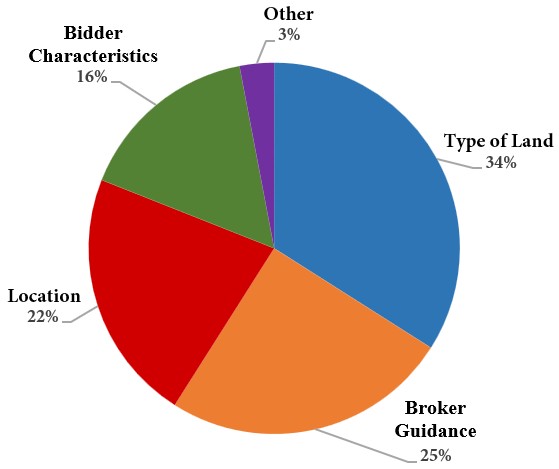
The major considerations for offering land through online or hybrid auctions reported by panel members, ranked in order, were the type of land (34%), broker guidance (25%), location (22%), bidder characteristics (16%), and other factors (3%). These findings indicate that both property characteristics and professional marketing guidance influence the selection of an auction method. Other considerations may vary depending on the property being offered for sale and the seller's objectives.
Agricultural real estate can be sold using several methods depending on the type of land, seller preferences, and current market conditions (Johanns, et al. 2020). Figure 2 summarizes the methods reported by panel members for agricultural land sold in Nebraska. Ranked by use, these methods included hybrid auctions (31%), traditional listings (29%), public auctions (17%), online auctions (14%), sealed bids (8%), and other methods (1%). These results indicate that hybrid auctions and traditional listings remained the primary approaches used to market agricultural real estate across the state.
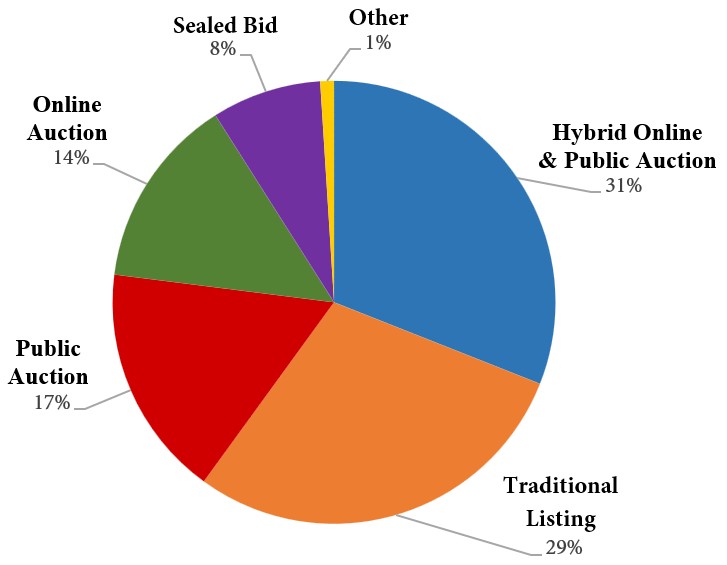
The selection of a marketing method may vary according to the characteristics of the property, anticipated bidder interest, and the objectives of the seller. Hybrid auctions combine in-person bidding with online participation so buyers can participate without traveling or arranging local representation. Traditional listings continue to provide an effective approach for marketing many agricultural properties. At the same time, public auctions, online auctions, and sealed bids remain important alternatives depending on the property and local market conditions.
Both the type of land and broker guidance were reported as the primary factors influencing the selection of online or hybrid auction methods in Nebraska. Hybrid auctions and traditional listings were the two most common transaction methods reported by panel members. Advances in technology have expanded opportunities to market agricultural real estate through multiple formats while increasing access for prospective buyers. Understanding the range of marketing methods used across Nebraska provides insight into current marketing practices and may help landowners and real estate professionals evaluate alternatives when selling agricultural property.
Survey results shown and discussed in this article are findings from the University of Nebraska–Lincoln 2026 Nebraska Farm Real Estate Market Survey. The survey's complete results can be found on the Nebraska Farm Real Estate website: http://cap.unl.edu/realestate.
Please address questions regarding the 2026 Nebraska Farm Real Estate Report to Jim Jansen at (402) 261-7572 or jjansen4@unl.edu.
References
Johanns, A. M., & Leibold, K. (2020, September). Getting Started in Farming: Inheriting a Farm-Ag Decision Maker, retrieved June 12, 2026, from Iowa State University Extension.
Moore, R. (2025, May 14). The Beginner’s Guide to Farmland Ownership-Navigating Your Journey as a Novice Landowner, retrieved June 11, 2026, from The Ohio State University Extension.
Ranells, N. (2025, July 18). Selling Your Farmland–NC FarmLink, retrieved June 9, 2026, from NC State Extension.


